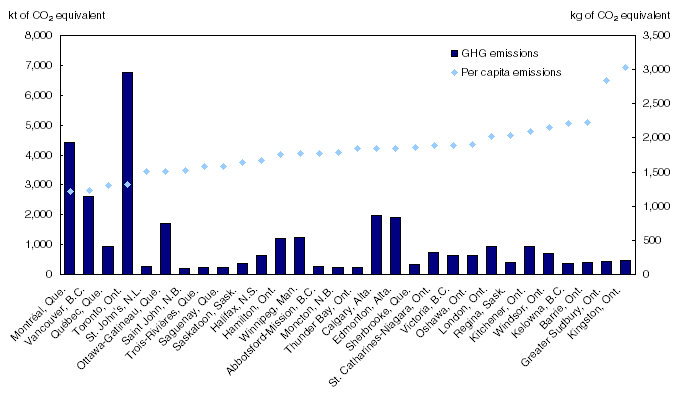
A recent analytical paper from Statistics Canada claims that Kingston, Ontario has the highest per capita private vehicle greenhouse gas emissions of all census metropolitan areas in Canada
Kingston, the city farthest to the right, sticks out quite a bit! (you'll have to click on the link to get a clean looking graph).
This prompted an article in the local newspaper, the Kingston Whig-Standard
entitled "Unsustainable" which focused on the environmental sustainability and climate change implications of this study.
But these days it pays to remind people of the dollar cost of our use of motor fuel, hence my letter to the editor as follows:
Kudos to the Whig Standard for reporting on last week's Analytical
Paper from Statistics Canada showing Kingston's per capita greenhouse
gas emissions from private vehicles to be the highest amongst all
census metropolitan areas in Canada ("Unsustainable", May 15). I wish
to point out that this fact is important for Kingston's economy too.
All those extra greenhouse gas emissions imply tens of millions of
dollars extra spent on motor fuel each year.
First of all, could the numbers from StatsCan report be wrong? After
all, it is strange that Kingston and, to a lesser extent, Sudbury,
have substantially more per capita emissions than all other
metropolitan areas. Kingston's private vehicle emissions were 3035 kg
per year per person , Sudbury's were 2844 kg, and in third, far
behind, was Barrie at 2221 kg, with the median for all cities being
about 1800 kg (Thunder Bay and Moncton were near the median).
Kingston's total private vehicle emissions figure of 462,000 tonnes/yr
roughly agrees with the result of a study that I did a couple of years
ago on Kingston's greenhouse gas footprint. That study, "Trends in Kingston's Community Greenhouse Gas Emissions (2000-2006)" which is available online at the City of Kingston website, used a completely
different methodology for calculating the emissions from vehicles
(StatsCan used the Canadian Vehicle Survey. I used data on how much
gasoline was purchased in the City of Kingston), but arrived at
roughly the same answer. So it's hard to believe that StatsCan made
some sort of mistake.
Now to the economic implications. The 460,000 tonnes of greenhouse gas
emissions from private vehicles comes from burning motor fuel - about
190 million litres of it every year. If Kingston's per capita vehicle
emissions went down to the median level for all cities, our motor fuel
use would decrease to about 110 million litres. With gas at about 90
cents a litre, that's $70 million dollars every year that we could be
spending on something else or just saving up for the future. One could
also think of it as 1400 jobs at a salary of $50,000 going out our
vehicle tailpipes every year.
Let's find out why Kingston's vehicle emissions are so high. Is it our
vehicle mix? Our public transportation system? Our city's layout? Are
we getting any benefits from this extra consumption of gasoline? If we
are not getting $70 million of benefits every year, what should be
done about it? Is this something that can be affected by our municipal
government's policies? If so, should it be an issue in this year's
municipal elections?
It is my sincere hope that this Analytical Report is, as the opening
line of the Whig story suggests, a shot of inspiration to Kingston in
its quest to really become Canada's most sustainable city -
environmentally and economically.

Showing posts with label greenhouse gas emissions. Show all posts
Wednesday, May 26, 2010
Monday, October 27, 2008
0.7% of GDP development aid target = revenue from a $30/tonne carbon tax, numerically and morally
At the recent Carbon Pricing and Environmental Federalism conference in Kingston, Ontario, one thing that was brought up by a couple of speakers (one of them was Matthew Bramley of the Pembina Institute) was the idea that taxes on greenhouse gas emissions, "carbon taxes", are actually a "recovered subsidy", and that, as a consequence, one could argue that it was more fair for the federal government to collect this tax (as opposed to provincial governments).
Let me explain this a bit before getting to my idea. Greenhouse gases are causing climate change, and that will be bad for everybody. Right now, people get to emit greenhouse gases (from burning fossil fuels) for free. But it's really not free because people in the future that will be burdened by climate change will pay the price. In effect, those people are giving a subsidy to the people who pollute for free today.
Money collected from a tax on fossil fuels would recover some of this subsidy. Who should get the proceeds? Well everybody benefits from reduced greenhouse gases, and the federal government would seem to have a better claim to represent "everybody" than individual provincial governments. Therefore, from this point of view it makes more sense that the federal government deserves the money.
Now to my point. Why stop there? We know that people who will really pay the price for climate change are the poor who live (or could have lived) in certain developing countries in the future. Aren't they the ones who are morally entitled to the proceeds of our carbon tax (in whatever form it is implemented)?
If you agree with my point then consider this: a $30/tonne tax on CO2, as proposed by the third year of Stephane Dion's Green Shift plan, would generate about $11b in revenue. That's coincidentally about 0.7% of Canada's $1.6 trillion GDP. Perhaps we should be considering fully funding Lester Pearson's (and the U.N.'s) suggested international development aid target using a $30/tonne carbon tax, and concentrating that aid on development that will prepare future generations to deal with climate change. What a great way to try to settle our debts and respect intergenerational equity.
Let me explain this a bit before getting to my idea. Greenhouse gases are causing climate change, and that will be bad for everybody. Right now, people get to emit greenhouse gases (from burning fossil fuels) for free. But it's really not free because people in the future that will be burdened by climate change will pay the price. In effect, those people are giving a subsidy to the people who pollute for free today.
Money collected from a tax on fossil fuels would recover some of this subsidy. Who should get the proceeds? Well everybody benefits from reduced greenhouse gases, and the federal government would seem to have a better claim to represent "everybody" than individual provincial governments. Therefore, from this point of view it makes more sense that the federal government deserves the money.
Now to my point. Why stop there? We know that people who will really pay the price for climate change are the poor who live (or could have lived) in certain developing countries in the future. Aren't they the ones who are morally entitled to the proceeds of our carbon tax (in whatever form it is implemented)?
If you agree with my point then consider this: a $30/tonne tax on CO2, as proposed by the third year of Stephane Dion's Green Shift plan, would generate about $11b in revenue. That's coincidentally about 0.7% of Canada's $1.6 trillion GDP. Perhaps we should be considering fully funding Lester Pearson's (and the U.N.'s) suggested international development aid target using a $30/tonne carbon tax, and concentrating that aid on development that will prepare future generations to deal with climate change. What a great way to try to settle our debts and respect intergenerational equity.
Wednesday, July 16, 2008
Ugh! Here come negative carbon taxes - gas subsidies from the automakers
I see that automobile companies are giving out gas cards worth roughly $1000 (got a flyer from Chrysler Canada in my mailbox recently saying they were giving out cards with $750 to $1,500 in gas depending on the model you buy) in an attempt to sell their big cars. Let's do an order of magnitude calculation and see what level of subsidy that amounts to. Let's assume that this vehicle gets 10 litres/100 km and is driven for 200,000 km over its lifetime. Then, over its life, it would use 20,000 litres of fuel. A gas card worth $1000 means a subsidy of 5 cents per litre of fuel over the life of the vehicle, order of magnitude.
Hmmm... the car companies, who are the best people in the world at selling cars, think that 5 cents per litre, equivalent to a negative carbon tax of about $20/tonne, will allow them to sell their gas guzzlers, that otherwise would rust on their lots. So, couldn't a positive carbon tax of that amount (roughly what's happening in BC) do an equivalent amount of good by causing people to buy fuel-efficient vehicles?
Okay, that was a pretty simplistic and rather rhetorical statement, but the point I want to make is that consumers do respond to price signals, and businesses even more so. It is quite incorrect to claim, as some do, that a carbon tax won't do anything to reduce greenhouse gas emissions.
Hmmm... the car companies, who are the best people in the world at selling cars, think that 5 cents per litre, equivalent to a negative carbon tax of about $20/tonne, will allow them to sell their gas guzzlers, that otherwise would rust on their lots. So, couldn't a positive carbon tax of that amount (roughly what's happening in BC) do an equivalent amount of good by causing people to buy fuel-efficient vehicles?
Okay, that was a pretty simplistic and rather rhetorical statement, but the point I want to make is that consumers do respond to price signals, and businesses even more so. It is quite incorrect to claim, as some do, that a carbon tax won't do anything to reduce greenhouse gas emissions.
Labels:
Carbon Tax,
gas card,
greenhouse gas emissions
Saturday, July 12, 2008
Canada's greenhouse gas emissions do matter to the world
A paper in Nature that has attracted some attention this week reminds me that I've been meaning to write about why it is important for Canada to reduce its greenhouse gas emissions, even though they represent only a few percent of the total world emissions. You sometimes hear critics of devoting resources to fight climate change say that reducing our emissions is not going to make any difference. However, "doing our part" to reduce emissions isn't like voting, obeying the speed limit, or playing a team sport. These examples are missing a crucial dynamic, that of competition and of a limited, public resource.
The problem of climate change caused by human emissions of greenhouse gases is an example of a tragedy of the commons. The image this term is meant to evoke is that of pastoral villagers, each with cows that graze on a shared grassy commons. What one villager's cows eat is lost to the others so every villager is tempted to use up the commons as quickly as possible. As for climate change, we all pay when someone uses the atmosphere (the commons) as a 'free' dumping ground. When a single person pays to reduce emissions, everybody else benefits. Sensible individuals might conclude that the best thing to do is to take advantage of the free dumping ground (burn fossil fuels) as much as possible. But if everybody were to think that way, everybody would lose in the end.
The way out of such a tragedy is cooperation. In the case of greenhouse gases, this might take the form of an agreement between all parties to limit emissions, or to pay for emissions. It is very important in this dynamic that everybody is seen by others to be cooperating. Nobody should be seen as 'getting ahead' by cheating because then everybody else would be encouraged to do the same and cooperation would break down.
This point is the key to why Canada must reduce its greenhouse gas emissions. Canada has one of the highest per capita emissions of greenhouse gases in the world. Cooperation can't happen when a few people are taking advantage of the commons a lot more than others. Cooperation is fostered by people providing moral leadership. In this respect the small, the weak, or the small-in-number have always, historically, had opportunities to lead.
The problem of climate change caused by human emissions of greenhouse gases is an example of a tragedy of the commons. The image this term is meant to evoke is that of pastoral villagers, each with cows that graze on a shared grassy commons. What one villager's cows eat is lost to the others so every villager is tempted to use up the commons as quickly as possible. As for climate change, we all pay when someone uses the atmosphere (the commons) as a 'free' dumping ground. When a single person pays to reduce emissions, everybody else benefits. Sensible individuals might conclude that the best thing to do is to take advantage of the free dumping ground (burn fossil fuels) as much as possible. But if everybody were to think that way, everybody would lose in the end.
The way out of such a tragedy is cooperation. In the case of greenhouse gases, this might take the form of an agreement between all parties to limit emissions, or to pay for emissions. It is very important in this dynamic that everybody is seen by others to be cooperating. Nobody should be seen as 'getting ahead' by cheating because then everybody else would be encouraged to do the same and cooperation would break down.
This point is the key to why Canada must reduce its greenhouse gas emissions. Canada has one of the highest per capita emissions of greenhouse gases in the world. Cooperation can't happen when a few people are taking advantage of the commons a lot more than others. Cooperation is fostered by people providing moral leadership. In this respect the small, the weak, or the small-in-number have always, historically, had opportunities to lead.
Thursday, July 3, 2008
Canadian examples of why, with high oil prices, we still need a carbon tax
A letter to the editor by one Bruce McCallum from Hunt River, PEI, in the Globe and Mail today contains two good examples of how higher oil and gas prices can cause increased emissions and pollution by shifting use to cheaper, dirtier fuels. He writes,
"the district heating plant in Charlottetown recently switched from relatively clean, but increasingly costly light oil, used for peak heating in the winter, to much dirtier, higher-carbon bunker oil, costing roughly half as much."
"Greenhouse owners from across Canada frequently contact me ... frequently mention that they are also considering switching to coal. Coal is cheap and plentiful, but it is the dirtiest, highest-carbon fuel available."
There is no federal tax on the burning of coal presently. It's enjoying a free ride at the expense of cleaner sources of energy.
Mr. McCallum's conclusion is also worth quoting, "Without carbon taxes to level the energy playing field and steer people toward green energy alternatives and efficiency, Canada's GHG emissions will to continue to rise."
"the district heating plant in Charlottetown recently switched from relatively clean, but increasingly costly light oil, used for peak heating in the winter, to much dirtier, higher-carbon bunker oil, costing roughly half as much."
"Greenhouse owners from across Canada frequently contact me ... frequently mention that they are also considering switching to coal. Coal is cheap and plentiful, but it is the dirtiest, highest-carbon fuel available."
There is no federal tax on the burning of coal presently. It's enjoying a free ride at the expense of cleaner sources of energy.
Mr. McCallum's conclusion is also worth quoting, "Without carbon taxes to level the energy playing field and steer people toward green energy alternatives and efficiency, Canada's GHG emissions will to continue to rise."
Labels:
Carbon Tax,
coal,
greenhouse gas emissions
Subscribe to:
Comments (Atom)


